AI Feels Useless Because It Can’t See Your Work (Long Version)
The FILE framework for turning fragmented work into AI-ready data

NOTE: A shorter version of this can be found here. Don’t have time to read, listen to an discussion on your way to work or while in the gym, click here
TLDR: AI feels underwhelming because your work is trapped across too many disconnected tools. The next wave of value comes when AI can operate directly on structured work data. The FILE framework solves this by keeping your work in durable plain-text files (Foundation), using models on top (Intelligence), automating workflows (Logic), and interacting through interchangeable apps (Experience). Start with one Markdown project file, then use AI to generate priorities, risks, and weekly status updates.
In this post, “AI” refers to your institution’s officially sanctioned tool (ChatGPT, Gemini, Claude, etc.).
Overview
If AI is truly as “magical” as they say, why haven’t your own efforts to use it been impressive? Why can’t you seem to see the value everyone else is talking about? Why does it feel like more fuss than it is worth?
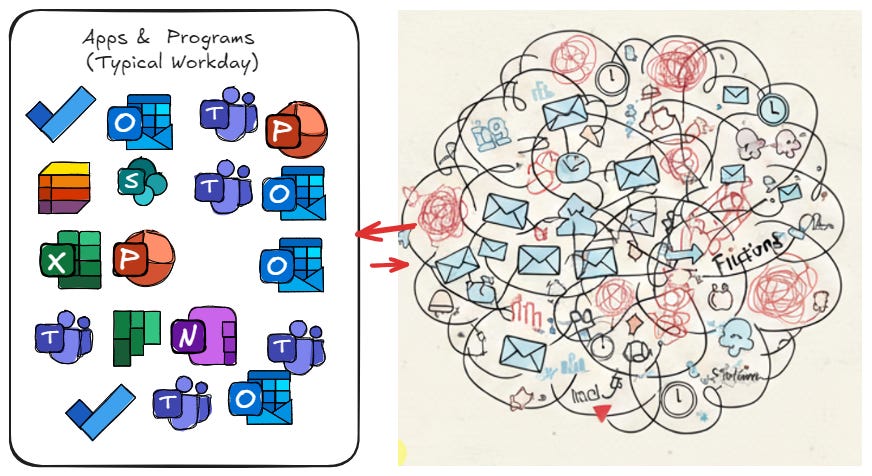
Let’s be honest: this is a typical week for most people whose job happens on a laptop. Emails. Meetings. Spreadsheets. Logins. Status updates. Repeated follow-ups.
So the real question is simple.
How can AI help us right now, using what we already have access to today, within the confines of organizational security protocols?
This post is longer than normal. I originally dictated my thoughts into Microsoft Word and used AI to help structure them. Over the last six months, I have been focused on understanding the real impact AI will have on the knowledge worker. Not the monthly model breakthroughs or the next flashy tool, but the deeper shift in how we as humans need to change the way we think and work.
Below, I will introduce the FILE framework.
Claude recently published a workflow called CoWork, designed to help programmers collaborate with AI more systematically. The same approach translates well to knowledge work.
I am building this framework for people who work inside real enterprise constraints. Our tools are often a year or two behind what is technically possible, and we still have to operate inside strict security and compliance boundaries. The goal is maximum AI leverage without breaking governance.
Cowork: Claude Code Power for Knowledge Work | Claude
The framework is simple, but it scales.
The 36-Month Frontier: Mapping the Edge of the Possible
In roughly 36 months, we went from AI being a niche tool used mostly by programmers to AI being available to anyone with an internet connection. The pace is not linear. It is compressing.
To understand where the puck is going, we need to see how the frontier has expanded across five overlapping stages.
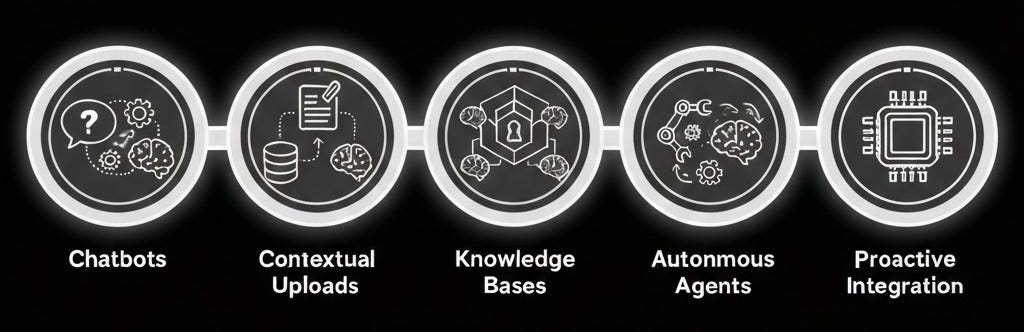
1) Chat Bots
This is the entry level: ask a question, get an answer, copy and paste.
This stage is often split into two groups: those who pay for a license and those who do not. The capability gap between free models and paid frontier models is often the first major hurdle in understanding why AI feels transformative for some users and underwhelming for others.
2) Contextual Uploads
This is the stage where users realize AI needs background to be useful.
Here, users develop custom prompts, upload specific files, or provide recurring context for repetitive tasks. This is where AI starts to move beyond one-off questions and into actual work.
3) Knowledge Base
Instead of uploading the same files repeatedly, you give the AI a foundational understanding of your work and your priorities.
This is still a chat-based system, but it becomes significantly more powerful. The AI starts to behave less like a search engine and more like a collaborator.
4) Autonomous Agents
This stage represents a shift toward independent operation. It splits into two paths.
Individual Agents: People build specialized assistants with custom instructions and knowledge bases for specific tasks. Tools like ChatGPT, Gemini, and Claude now make this accessible without coding.
Multi-Agent Teams: Multiple agents coordinate to accomplish a goal with minimal human involvement. For example: one agent processes data, another drafts a report, and a third audits the output for errors.
5) AI-First Workflows
This is the current edge of the frontier, and the focus of this post.
AI-first workflows require the AI to interact directly with your systems, your files, and your work artifacts. This is where AI becomes operational instead of conversational.
This is also where most organizations are not ready.
The Real Problem: Fragmented Work
If you had to surface your highest-priority task or identify a critical project bottleneck right now, could you find the answer in seconds?
Or is your work buried behind a login button across a fragmented stack of Outlook, Planner, To Do, Project, Excel spreadsheets, and SharePoint folders?
The modern knowledge worker is not failing because they are lazy.
They are failing because their work is fragmented across too many systems that do not talk to each other.
A Better Mindset: Treat AI Like a System, Not a Toy
AI is extremely capable at summarizing, organizing, and transforming information. It is also unreliable in predictable ways.
Many people treat AI errors as proof that the tools are useless. That is the wrong lesson. The better lesson is this:
When AI output is wrong, the cause is usually one of three things.
Missing context
Unclear instructions
A model limitation
The fix is not blind trust, and it is not rejection. The fix is to treat AI output like a draft and audit it.
This is also why a single, evolving file of personal instructions becomes powerful. Every time you clarify something to the AI, you should add that clarification to your master instruction list.
Over time, you stop prompting from scratch. You build a stable operating system for how the AI should support you.
Redefining the Knowledge Worker as a Manager of Systems
A knowledge worker is anyone whose primary value comes from judgment, synthesis, and prioritization rather than repetitive execution.
Whether you are an analyst, a researcher, or an administrator, your effectiveness depends on your ability to manage three core domains.
Your knowledge
Your time
Your projects
The historical model of productivity assumed that specialized apps would save us time.
Instead, we have moved toward a model of fragmented attention.
In the AI era, relying on manual dashboards and reminders scattered across separate apps is too slow.
Individuals who combine domain expertise with AI-augmented management will see their leverage multiplied.
Those dependent on manual lists and scattered notes will experience a growing lag between intention and execution.
Skating to the Puck
The most common strategic error is reacting to what AI can do today, like writing an email, rather than positioning for where it is headed.

The puck is moving toward autonomous operators.
These are systems that work directly on raw data to manage schedules, tasks, and project health.
If your project history is locked in a database that requires a login, you have effectively blinded the AI agents of tomorrow.
To build an AI-ready productivity system, we use the FILE framework.
This ensures your system remains durable even as specific AI tools and models change.
The FILE Framework
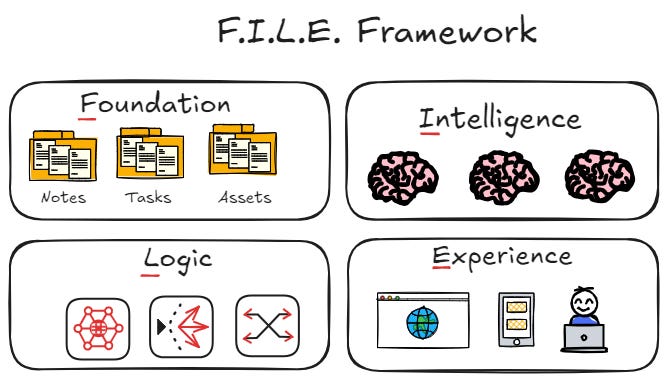
F: Foundation (The Filesystem)
This is your local directory.
It consists of folders containing plain-text Markdown (.md) files for notes, tasks, and logs.
This layer is stable, vendor-independent, and fully owned by you.
Your to-do list is a file, not an entry in a proprietary database.
I: Intelligence (The Models)
This is the AI layer.
These are the language models that reason over your foundation. Today it might be GPT-4o or Claude. Tomorrow it will be something else.
Because your data is stored as plain text, you can swap models without rebuilding your entire workflow.
L: Logic (The Orchestration)
This is where automation lives.
This layer determines how a weekly status report is generated from your daily logs, how tasks are extracted, and how project risk is flagged.
It replaces manual tracking with repeatable processes.
E: Experience (The Interface)
This is how you interact with your system.
You might use Obsidian, VS Code, or a mobile text editor. These are lenses. They are interchangeable and do not own your information.
Why Markdown Is a Practical Interoperability Layer
Markdown (.md) is a simple plain-text format.
Just as Microsoft Word uses “Heading 1,” Markdown uses #.
Because it is lightweight and structured, an AI can scan large volumes of Markdown files quickly and reliably.
Markdown wins because it is a Goldilocks format.
It is readable for humans and easy for machines to parse.
It also provides three advantages that most proprietary tools do not.
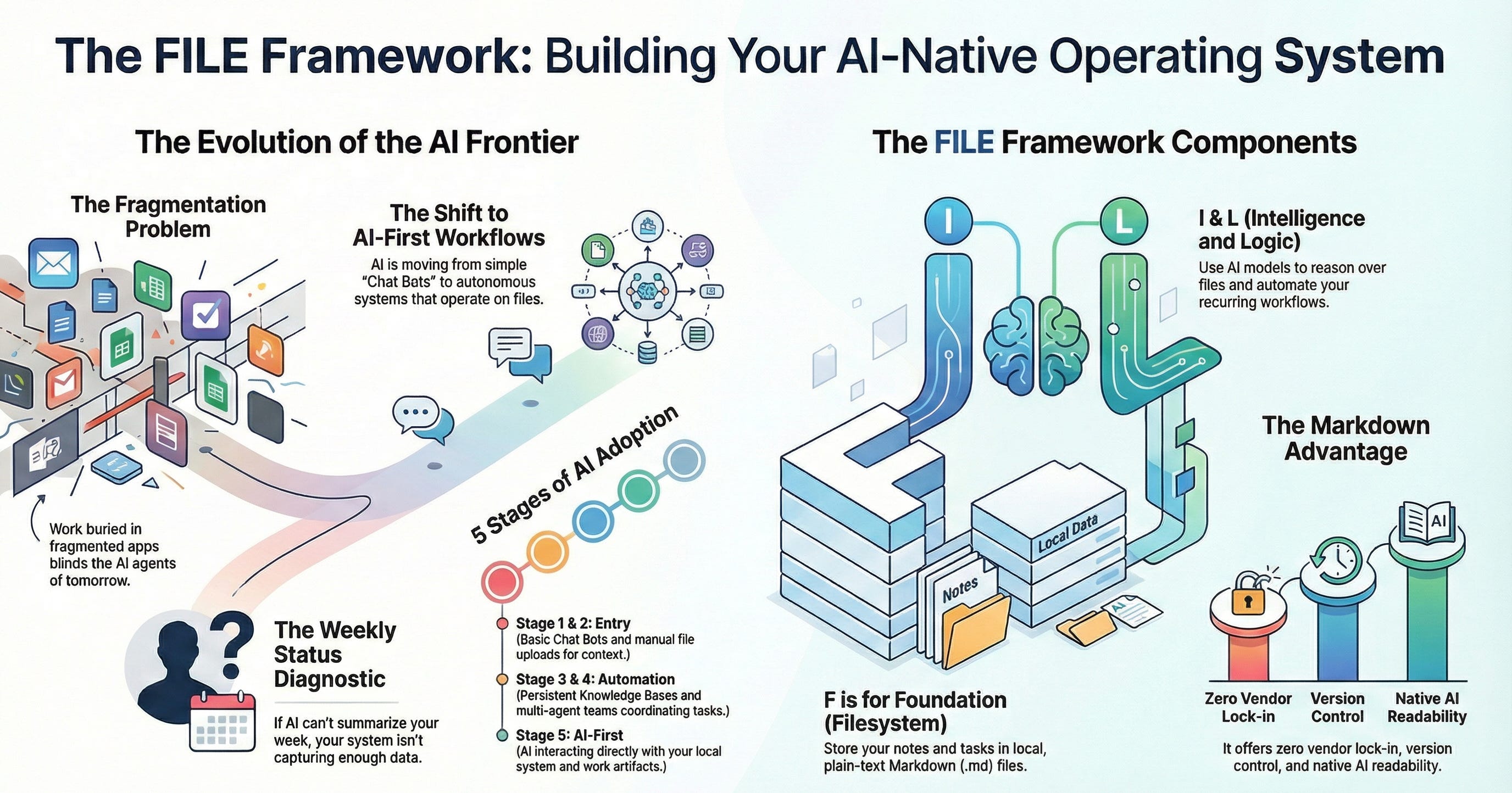
1) Zero dependency
No accounts, no licenses, and no vendor lock-in.
Even if every productivity platform you use disappears, your project history still exists as files you can open anywhere.
2) Version control
You can track how a project’s scope changed over time.
You can see when decisions were made.
You can reconstruct the evolution of your work.
3) AI-native readability
Markdown is one of the easiest formats for modern language models to reliably parse and transform.
A model can read a Markdown task list and immediately convert it into a structured plan, a schedule, or a draft status report.
When you use proprietary systems, you add friction between your work and the AI.
When you use Markdown, you reduce that friction.
Enterprise Reality: This Complements, Not Replaces, Official Systems
One important clarification.
This is not an argument to abandon organizational systems of record.
Tools like Planner, Project, Outlook, and ticketing systems exist for real reasons: collaboration, permissions, audit trails, retention policies, and continuity.
The FILE framework is a personal layer.
It is the system you control.
It is the bridge between your work and your AI tools.
The goal is not to replace official systems. The goal is to ensure your personal operating system is durable, portable, and AI-ready.
Implementation: Personal Strategic Advantage
Over time, organizations will likely shift toward more open and accessible data structures that AI can operate on.
Markdown files appear basic, but the applications that use them can be powerful. Obsidian, VS Code, and similar tools can support everything from Kanban boards to knowledge graphs.

The real advantage is not the app.
The advantage is that your data is portable.
A Concrete Example: The Weekly Status Report
Here is what an AI-first workflow actually looks like.
You maintain a project file that includes:
Scope
Tasks
Decisions
A running log of updates
At the end of the week, you give the AI the file and ask:
What changed this week?
What are the top 3 risks?
What tasks are blocked and why?
What decisions were made?
What should the next week’s priorities be?
If the AI cannot answer those questions, that is not a failure.
That is a diagnostic.
It tells you what your system is not capturing yet.
The First Steps
If this is new to you, here is what I suggest.
1) Create a master file for your next project
For your next project, create a single Markdown file with headings for:
Scope
Tasks
Decisions
Log
Think of the log like a save point in a video game.
2) Upload it to an AI
Give this file to an AI tool you already have access to.
Ask it to behave like a project manager.
If it cannot answer, add a new section to your file so that the information exists next time.
3) Bridge the gap
If your data is trapped in systems like GitHub, Planner, or SharePoint, export what you can and paste it into your file.
Do not do this forever.
Do it as an experiment.
See what questions the AI helps you answer, and identify what information is missing.
Final Thought
Stop optimizing applications.
Start optimizing for data.
Files first. Markdown everywhere. AI on top.
By adopting plain text as your primary substrate, you create the conditions required for AI systems to operate at scale.
The winners will not have better prompts. They will have better data.
The real question is whether we will keep building digital silos, or whether we will commit to building a readable foundation for our work.