Leveraging AI in Proposal Development
A New Age Workflow

Introduction
In today's fast-paced business and academic arenas, drafting proposals can be a daunting task. From understanding intricate RFP requirements to crafting budgets , the process is often complex and time consuming. However, integrating AI into this workflow can drastically streamline operations and increase the chances of success. Here's a closer look at a potential AI-enhanced proposal workflow:
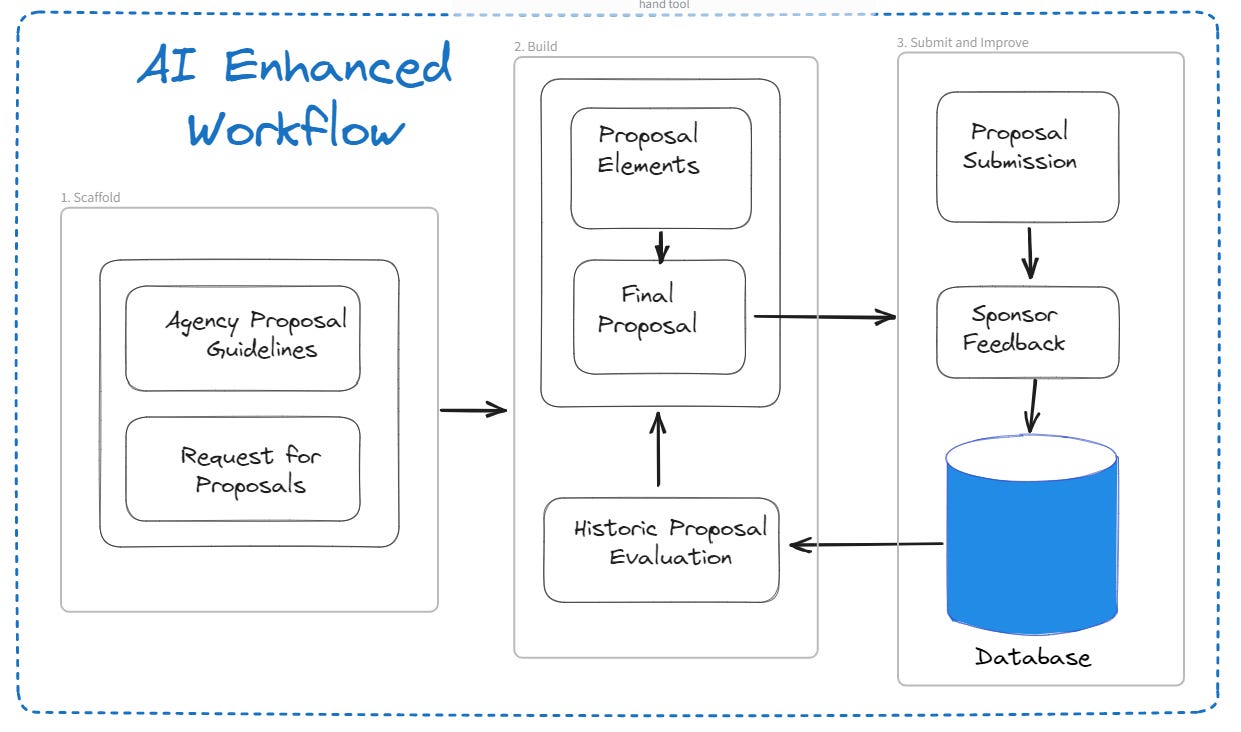
Agency Guidelines & Request for Proposals (RFP)
Before diving into proposal writing, it's crucial to understand the agency's guidelines and their specific requirements. The RFP is a document that outlines what the agency is looking for in a proposal. Shown in first element in above diagram.
AI's Role: Advanced AI systems can scan through extensive RFP documents, highlighting key requirements, dates, and deliverables. This ensures that no critical detail is overlooked and that the proposal aligns perfectly with the agency's expectations.
Crafting the Proposal Elements & Finalizing the Document:
This stage involves creating the proposal, including all its elements such as project plans, technical solutions, budgets, and more. Middle element in above diagram.
AI's Role: AI-driven writing assistants can offer suggestions to improve the clarity and persuasiveness of the content. Additionally, AI tools can predict the potential success rate of a proposal based on historical data, allowing teams to make necessary adjustments before finalizing.
Proposal Submission & Gathering Feedback:
Once the proposal is ready, it's submitted to the agency. After a review, feedback is provided, which can be either positive (leading to a funded project ) or constructive (Not-Funded). This panel feedback is fundamental in helping to improve future proposals, but, more often than not this information is kept by the PI of the proposal and not shared. Here we are suggesting a centralized database of all panel feedback which will benefit not just only the PI, but the entire institutions or research group. This is shown in the right hand element in above diagram.
AI's Role: AI can automate the submission process, ensuring that all required documents are attached and that the proposal reaches the right contacts. Post submission, AI tools can analyze feedback, categorizing comments to understand common areas of improvement.
Database Integration for Continuous Improvement:
All the data from the submission and feedback phase is stored in a database. This isn't just for record-keeping; it plays a pivotal role in refining future proposals.
AI's Role: AI algorithms can sift through this database to identify patterns. For instance, if a certain proposal structure consistently receives positive feedback, AI can recommend this structure for future proposals. Conversely, if a particular part of a proposal is often criticized, AI can flag this as an area needing revision.
Conclusion
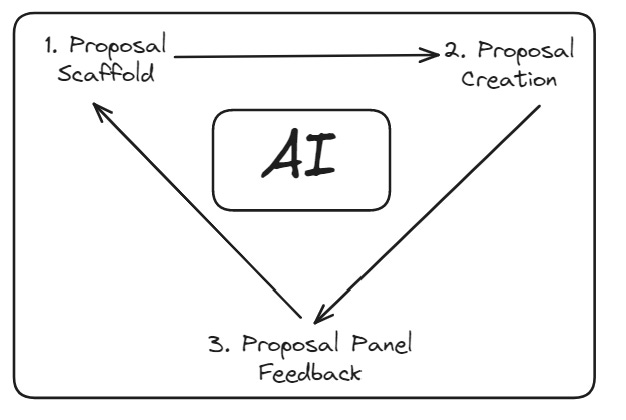
The integration of AI into the proposal development process is set to revolutionize the way teams approach, draft, and refine their proposals. By automating mundane tasks, offering insightful recommendations, and continuously learning from past data, AI promises not only to alleviate the stresses of proposal writing but also to significantly enhance the probability of success. With the rise of AI tools like ChatGPT in the past 12 months, it's a challenge to stay updated. Yet, as of now, the infrastructure isn't fully developed to effortlessly implement the aforementioned proposal workflow. However, this shouldn't deter institutions. It's the ideal time for them to prepare their data systems for the inevitable integration of AI. This preparation can be initiated by meticulously documenting, cleaning, and streamlining their existing workflow processes, paving the way for a smoother AI transition in the near future.