Part 1: Collaborative AI Agents & Agentic Workflows
Leveraging self feeding AI Bots for Improved Performance

This is a 2 part post, part two will be an example of how you can “mimic” agentic workflows within a standard chat bot.
Introduction to One-Shot Prompts
ChatGPT distinguishes itself with its proficiency in handling "one-shot" prompts. This is where a input. This feature allows ChatGPT to flexibly adapt to diverse requests and commands, exemplifying its broad linguistic comprehension. It can produce outputs in a variety of contexts, including creative writing, technical documentation, and everyday conversation, by leveraging its sophisticated, AI-driven grasp of language.
No prior inputs are needed, simply ask your question or explain your task and it will respond. The better your prompt, the more useful the answer.
Limitations of One-Shot Prompts
Despite the impressiveness of one-shot prompts, they come with their own set of restrictions. When dealing with intricate contexts, staying informed with the latest knowledge, and guaranteeing precision, these limitations surface due to the dependence on a solitary piece of instruction and the static nature of the model's knowledge—which only extends up to its last training.
Enhancing AI Output
Improving Outputs in Complex Tasks
To circumvent the constraints of one-shot prompts, especially for intricate or substantial documents, one needs to adopt a clear mental structure and workflow. Imagine having to write a concise, technical guide—like a tutorial for creating a Power BI report—without the ability to edit the document or jot down notes. The task becomes significantly more challenging, demanding a well-organized thought process that can be executed smoothly from start to finish. Difficult as it may be this is how AI bots typically work, they do not know the exact words they are going to write ahead of time.
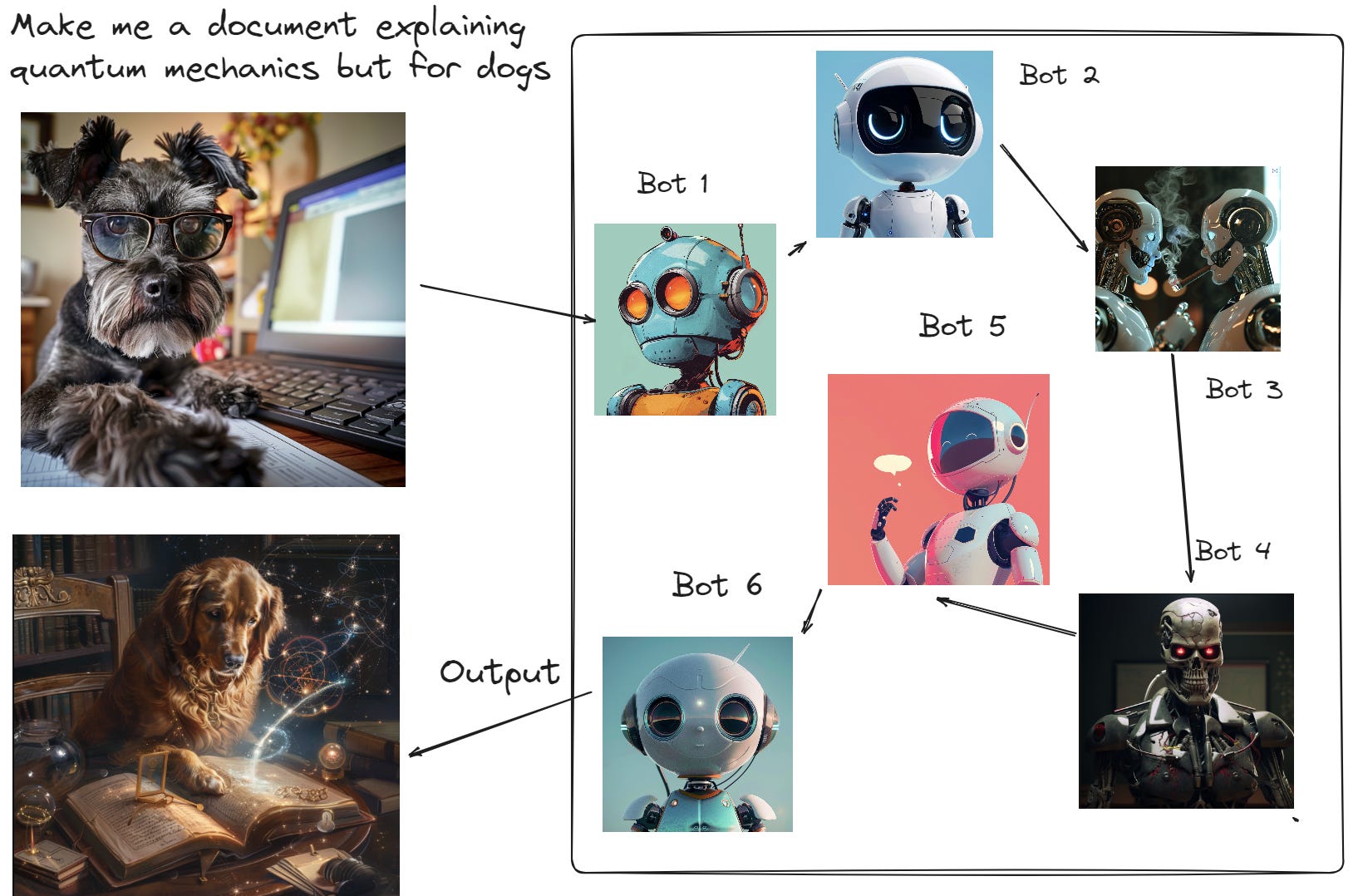
This leads us into the concept of an AI Agent, which in its simplest form can be understood as “feeding” the output from one prompt into the input to another prompt.

AI Agents and the Future of Artificial Intelligence
Agentic Workflows: The New Paradigm
One of the key advancements with AI agents (custom bots) is the development of "agentic workflows." These processes allow AI to iteratively work on tasks—improving outputs through repetition in a way that mirrors human creativity and analysis. By enabling AI to feed and refine its output continually, agentic workflows enhance the collaboration between humans and AI, pushing the boundaries of productivity and innovation.
Collaborative AI Ecosystems
The future seems poised for an environment where collaborating AI agents become standard. By harnessing the strengths of different AI agents, we can create complex systems that emulate the multifaceted nature of human teamwork. This collaboration expands the capacities of individual agents and sets the stage for a new wave of AI integration across various sectors, enhancing innovation and efficiency.
Conclusion
The advent of AI agents and agentic workflows represents a pivotal moment in the evolution of artificial intelligence. With the possibility of dynamic, self-governing agents working together on complex tasks, we are approaching a new era of technological progress. This era promises to revolutionize our digital interactions, opening up limitless opportunities for growth, innovation, and collaboration.